Showing posts with label Estonia. Show all posts

May 9, 2012

Europa 2012 stamps from ESTONIA

Stamp Name:Europa 2012.
Details:
Estonia is a small northern country with interesting history and pristine nature, it's a friendly and a modern country. It takes only 5 days to cover all of Estonia and its islands, everything is so close here. Forests, lakes, bogs and sandy beaches all give an unforgettable sight. Winters are cold here, you can go to the islands over the ice roads. Estonian population is small, approximately 1.3 million people. Everyone is hard working, welcoming, thinks highly of their family and is eager to learn new things.
Estonia is known for its e-country, Skype and many other achievements in medicine and technology. Over the centuries Estonia has been a part of Sweden, Denmark, Germany and also Russia. They have all left something of their culture, changed landscapes and architecture. The old town of Tallinn is one of the most well preserved and protected medieval towns in Europe (UNESCO cultural heritage). Estonians are a singing nation - there is a nationwide singing and dancing festival in every 5 years. Come see and listen to this land and its people!

Sep 19, 2011

St Margharet’s of Karuse FDC from ESTONIA

FDC Name:St Margharet’s of Karuse.
Issue Date:25th AUG'2011
Details:
St Margaret's of Karuse was built in the third quarter of the 13th century as a fortified church next to a trade route passing from Saaremaa to North Estonia. It is one of the oldest West-Estonian churches. Master of the Order Otto von Luttenberg, who fell in a battle against the Lithuanians on the Suur väin (Moon Sund) ice near Karuse in 1270, is believed to have been the builder of the church and is probably buried in it. St Margaret's of Karuse is a nave-only church with Romance and early Gothic influences. Its oldest part is the choir, which is narrower and lower than the rest of the building. The interior features a Baroque pulpit by the famous German woodcarver, Christian Ackermann (1697), a 16th century chandelier and a late 18th century altar. The altarpiece is an 1888 copy of an Albert Dürer's motif by B. Baggern. There are some 13th century grave slabs and stone crosses in the churchyard.
Technical Details:
Price: 0.35
Date: 25.08.2011
Print: offset
Designer: Riho Luuse
Perforation: 14:13¾
Sheets: 5x4
Quantity issued: 50 000
Printing house: AS Vaba Maa
Remark:Thanks Pirjo for the FDC.

Sep 11, 2011

20th anniversary of the restoration of independence FDC & stamp from ESTONIA

FDC Name:20th anniversary of the restoration of independence
Issue Date:20th AUG'2011
Details:
On August 20 the Supreme Council of the Republic of Estonia passed the decision on the independence of Estonia. The decision restored the independence of the Republic of Estonia declared in 1918, which had been defended in the War of Independence in 1918-1920 and had been lost when the Soviet Union first occupied and then unlawfully incorporated Estonia. In the period of four years prior to the restoration of independence the Estonians' aspiration for liberty had been seeking for an outlet more and more vigorously; its immediate incentive, however, was a coup attempt on the previous day in the Soviet Union. 
The first foreign country to recognize the independence of Estonia was Iceland on August 22, followed by recognition by Lithuania, Latvia, Russia (on August 24) and other countries.(Source-Estonia Post)
Technical details
Price: 0.35
Date: 20.08.2011
Print: offset
Designer: Indrek Ilves
Perforation: 13¾ : 14
Sheets: 5 x 5
Quantity issued: 50 000
Printing house: AS Vaba Maa
Remark:The FDC with the stamp showing the building & One additional definitive stamp to cover the international postage.Thanks Pirjo Falten for sending such a nice FDC on the issue date.

Sep 1, 2011

European Athletics Junior Championship FDC & Stamps from ESTONIA

FDC Name:European Athletics Junior Championship
Issue Date:20-07-2011
Details:
For the first time ever the European Athletics Junior Championships will be held in the capital city of Estonia - Tallinn through 21-24 July. The historical Kadriorg Stadium will host over 1000 young athletes from 47 European countries during the Championships, making it the biggest athletics’ event ever held in Estonia. Welcome to Tallinn!
Remark:Thanks Pirjo Faltan for sending this FDC on the issue date.Looking forward for more FDC in future.

Jun 6, 2011

European Brown Hare FDC from ESTONIA

FDC Name:European Brown Hare
Issue date:19th MAY'2011
Details:
European Brown Hare (Lepus europaeus Pall.) In Estonia, the European or brown hare is a species that settled in the area from the south about 200-300 years ago when a part of their forest habitats had been replaced by fields. As a result it is also called the field hare. As the scientific name indicates it has spread throughout Europe and is absent only in northern parts of Scandinavia. The European hare is the biggest species of the genus Lepus, weighing from four to five (up to 7.4) kilograms and bearing one to six (seven) well-developed offspring, whom it suckles for about one month. The number of those small game animals has fallen throughout Europe during the past half-century. The reasons are varied, starting from numerous carnivores, birds of prey, extensive agriculture and its chemisation to viral diseases. As late as in the 1960s more than 10,000 European hares were hunted and more than 100,000 of them were counted in Estonia. At the beginning of the 21st century hardly 1,000 animals a year are shot. No counts are being carried out at present, but the number of European brown hares is assessed at slightly above 20,000.(Source Estonia Post)
Technical Details
Price: 0.35
Date: 19.05.2011
Print: offset
Designer: Sándor Stern
Perforation: 12¾ : 13
Sheets: 4 x 5
Quantity issued: 60 000
Printing house: AS Vaba Maa
Remark:Thanks Pirjo for the nice FDC,The first day cancellation is superb.The stamp is also beautiful.

May 29, 2011

Accession to the euro FDC from ESTONIA

FDC Name:Accession to the euro.
Issue date:1st JAN'2011
Details:
From the 1st of January 2002 a common currency, the euro, was introduced in twelve countries of the European Union. It was possible to make bank transfers in euros already starting from 1999 but the seven euro banknotes and eight coins came into use three years later. The euro denomination appeared parallel with the kroon on an Estonian postage stamp for the first time in 1999 when the stamp dedicated to the 50th anniversary of the Council of Europe was issued. In the period from 2006 to 2010 the face value on Estonian stamps was shown in both kroons and in euros. The stamp issued to mark Estonia’s transition to the euro currency is the first Estonian stamp on which the face value with the symbolical denomination of €1 is indicated in euros alone. Postage stamps with the face value in kroons will be valid for postage until December 31, 2013; stamps with the face value in two currencies will be valid for postage indefinitely.
Technical details:
Print: Offset
Designer: Indrek Ilves
Perforation: 11¼ : 11¼
Sheets: 2x5
Quantity issued: 1 000 000
Printing house: AS Vaba Maa
Remark:Nice FDC posted by my good friend from Estonia on the Issue date.

May 27, 2011

Definitive stamps FDC from ESTONIA

FDC Name:Definitive stamps
Issue Date:3rd JAN'2011
Details:This is the 1st definitive set of 5 stamps from Estonia.The stamps & FDC was designed by designer- Lembit Lõhmus
Remark:Thanks Pirjo for sending this FDC on the issue date.

May 7, 2011

Folk Costumes FDC from ESTONIA

FDC Name:Folk Costumes
Issue date:14th APRIL'2011
Details:
Clothes of more or less the same type as elsewhere in North Estonia were worn in Harju County, although wide differences can be found particularly in the colours and decorations of women’s dress. From Jõelähtme near Tallinn a girl and a woman from the first half or the middle of the 19th century have been reproduced on the stamp. The girl’s headgear is a so-called eared wreath and a wide red band decorates her green-striped skirt. The girl’s sleeve embroidery is rather simple, but the sleeves of the married woman who sports an embroidered apron are decorated with lavish wide embroidery. She wears a pot hat lined with silk. Gradually spreading, such hats crowded out the earlier traditional women’s headgear. The Rapla woman on the other stamp also wears a hat. The so-called eye brooch with red stones was a popular festive decoration. The Rapla woman wears white embroidered sleeves, a skirt with horizontal stripes of a more modern type and a purchased apron with large flowers embroidered on it. The man with the bagpipe wears a grey jacket and light pants with blue stripes. The traditional and quite widespread man’s suit in North Estonia was navy blue.(Source-Estonia post)
Technical Details:
Price: 0.35
Date: 14.04.2011
Print: ofset
Designer: Mari Kaarma
Perforation: 13¾ : 14
Sheets: 5x5
Quantity issued: 100 000
Printing house: AS Vaba Maa  
Remark:Thanks Pijo Faltan for sending such a beautiful FDC on Folk costumes of Estonia.Both the stamps are beautiful.Estonia post has issued a maxi-card on the lower value stamp of 0.35 EUR.

Apr 17, 2011

2011-Flower Peony FDC from ESTONIA

FDC Name:Flower Peony.
Issue Date:24th MAR'2011
Details:
The peony or paeony is a name for plants in the genus Paeonia, the only genus in the flowering plants family Paeoniaceae. They are native to southern Europe, East Asia and western North America where they grow in grasslands, brushwoods and in valleys between mountains. It is a flowering plant appreciated because of its frost-hardiness, longevity and stamina, its beautiful and lasting leafage, height of the shrub, size and beauty of the flower as well as the diversity of its shapes and colours, its long period of blossoming and durability as a cut flower. They have meaty, tuberous roots called bulblets and large seeds in erect follicles. The Chinese peony (Paeonia lactiflora) featured in the stamp has tripartite leaves with elliptical or lanceolate leaflets usually with sharp ends, dark green on top and light on bottom. The height of the plant is between 80 to 100 cm and the flowers are 8 to 12 cm in diameter, blossoming in June and July. It is the base of two thirds of garden peony varieties and about 10,000 varieties are known(Source-Eesti Post)
Technical Details:
Price: 2.32
Date: 24.03.2011
Print: offset
Designer: Ülle Marks, Jüri Kass
Perforation: 12¾ : 13
Sheets: 2x2
Quantity issued: 41 500 poognat / sheets
Printing house: AS Vaba Maa
Remark:Thanks Falten for sending such beautiful FDC to me on the issue date.The design of the stamps and the art work is superb.

Mar 6, 2011

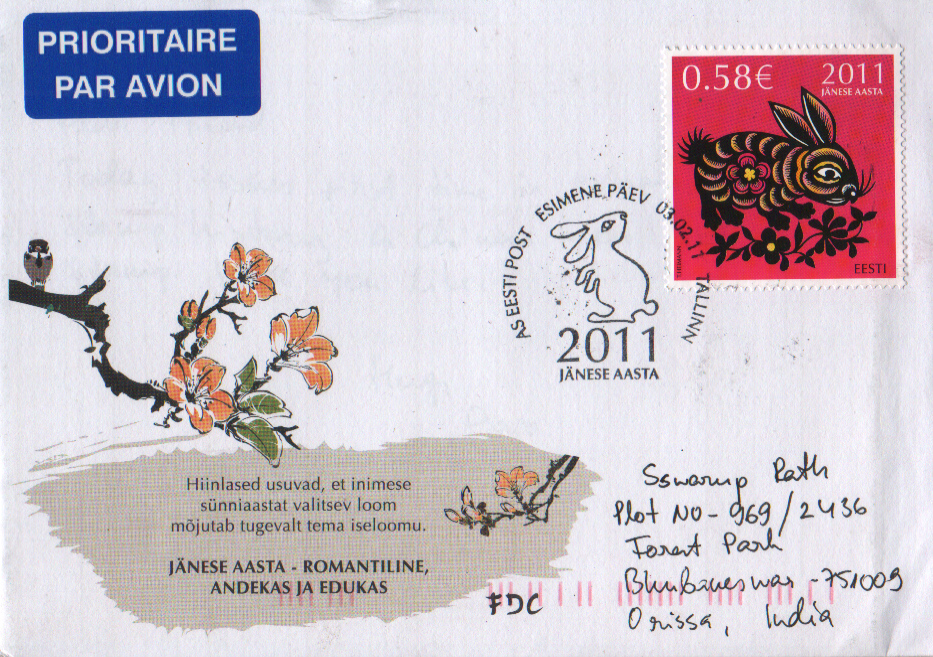
2011-Year of Rabbit (Hare)FDC from ESTONIA

FDC Name:Chinese New Year - Year of the Hare
Date Of Issue:3rd FEB'2011
Details:
According to the Chinese zodiac calendar the new year this year falls on February 3, ushering in the Year of the Hare. The Hare (or the Rabbit) is regarded as the most propitious among the twelve signs of the zodiac because it is a symbol of longevity. People born in the Year of the Rabbit are articulate, talented, and ambitious. They are virtuous, reserved, and have excellent taste. Rabbit people are admired, trusted, and are often financially lucky. They are fond of gossip but are tactful and generally kind. Rabbit people seldom lose their temper. They are clever at business and being conscientious, never back out of a contract. They would make good gamblers for they have the uncanny gift of choosing the right thing. However, they seldom gamble, as they are conservative and wise. They are most compatible with those born in the years of the Sheep, Pig, and Dog.(Source-Estonia Post)
Price: 0.58
Date: 03.02.2011
Print: ofset
Designer: Triin Heimann
Perforation: 12¾ : 13
Sheets: 4 x 5
Quantity issued: 60 000
Printing house: AS Vaba Maa
Remark:Thanks Pirjo for the year of Rabbit FDC.

Jan 25, 2011

2010 Christmas FDC from ESTONIA

FDC Name:Christmas
Issue Date:25th DEC'2010
Details:
Fluffy snowflakes are playfully swirling up and down. „The evening has somehow become very quiet,“ I tell them and put two small gingerbreads into my mouth. On that day there is something extraordinary taking place everywhere. It is a mixture of pumpkin jam and black pudding, spruce needles and brisk air, candles and presents packed into colourful paper. I sit on the sledge, holding my bag in front of me and merrily slide down the hillock. „There seem to be more of you than usual,“ I tell the stars and eat another gingerbread. Santa's helpers march across the icebound lake, I pat them on their shoulders and run home. The others are waiting for me already. Happy Christmas!
Print: offset
Designer: Tiina Reinsalu
Perforation: 11¼ : 11¼
Sheets: 2x5
Quantity issued: 1 500 000
Printing house: AS Vaba Maa
Technical Details: ( For the Topmost FDC)
Price: 0.58
Date: 25.11.2010
Print: offset
Designer: Liisa Hallik, Maarja Kotkas
Perforation: 11¼ : 11¼
Sheets: 2x5
Quantity issued: 400 000
Printing house: AS Vaba Maa 
(Source-Essti Post)
Remark:Thanks Pirjo for sending this two lovely Christmas FDC.We will continue our exchange in 2011.Happy New Year to you.

Oct 30, 2010

WWF. Great Crested Newt FDC from ESTONIA

FDC Name:WWF. Great Crested Newt.
Issue Date:14th OCT 2010
Details:
The great crested newt (Triturus cristatus) is a species in the class of Amphibia, the order Caudata and the family Salamandridae. It lives in North and Central Europe in territories lying north of the Alps and the Danube. In Estonia the great crested newt mainly lives on the continent and is more numerous in Southeastern Estonia. An adult newt can grow up to 18 cm long, the female being slightly shorter than the male. The colour of the great crested newt depends on its living environment, but it is usually dark – black, brownish or grayish on the back and yellow or orange with dark patches underneath. The skin is rough like that of the toad. During the mating period the male develops bluish white stripes on the sides of the tail and a relatively high crest, which stops at the stump of the body and has given the name to the species. Females get a narrow yellow line down the spine, but they have no crest. The great crested newt prefers as its habitat forest lakes with no fish in them, ponds or pools, but can be found also in cultural landscapes with large rive valleys. The great crested newt is a protected species in Estonia.
Technical Details:
Denomination: 36.00
Date: 14.10.2010
Print: Ofset
Designer: Lembit Lõhmus
Perforation: 14 : 13¾
Sheets: 4 x 2
Quantity issued: 200 000
Printing house  : AS Vaba Maa
Remark: Thanks  Pirjo for sending such a beautiful WWF FDC by registered post on the issue date.This is indeed a great official FDC.I love all the wwf stamps ,FDC & maxicards as this is one of the very intersting topic.
WWF was established as a Charitable Trust on November 27, 1969, it has an experience of over four decades in the field. From a modest beginning, the organization was propelled forward by the efforts of its founders and associates who volunteered their time and energy to lend momentum to this movement.
WWF mission is "to halt and reverse the destruction of our environment". Currently , much of its work focuses on the conservation of three biomes that contain most of the world's biodiversity: forests, freshwater ecosystems, and oceans and coasts. Among other issues, it is also concerned with endangered species, pollution and climate change.
I invite all my friends and this blog readers to be part of this mission as to preserve this beautiful Earth for our next generation.Thanks & be in this movement.....Please visit

Oct 7, 2010

Estonian fauna: Garden dormouse FDC from ESTONIA

FDC Name:Estonian fauna: Garden dormouse.
Issue Date:23rd SEP'2010
Details:
This stamp in the Estonian Fauna series is dedicated to the dormouse (Eliomys quercinus L.). The dormouse is a rodent the size of a young rat. It is an omnivore and eats plant fruits, seeds as well as snails, insects and even smaller rodents. Waking in the spring the animal only weighs about 45 grams but by the fall it acquires an abundant store of fat and then weighs nearly 120 grams. The multiply twice a year, with mostly 4 to 6 young in the litter. Dormice prefer deciduous and mixed forests with the presence of oak and hazelnut trees, as well as dry-stone walls and old farm seats. Sometimes they live in houses and outbuildings. Dormice are found in most parts of Europe but their population has seriously fallen in most parts of its area for unknown reasons. They are only known to nest on the mainland, but there is a community on Suur-Tütarsaar Island in the Gulf of Finland. Due to its relatives rarity the dormouse is listed in the 2nd category of protected species. As there is practically no information about dormouse finds in Estonia it has been entered into the category of species with deficient data.
Denomination: 5.50
Date: 23.09.2010
Print: ofset
Designer: Sandor Stern
Perforation: 12¾ : 13
Sheets: 4 x 5
Quantity issued: 50 000
Printing house: AS Vaba Maa
Remark:Thanks Pirjo for the nice Fauna FDC on Dormouse.The watercolor of dormouse on FDC is very good.

Aug 24, 2010

Estonian Manor Hall FDC from ESTONIA

FDC Name:Estonian Manor Hall.
Issue Date:5th AUG'2010
Details:
The Suuremõisa, originally Pühhalep (Pühalepa), Manor on Hiiumaa Island was established in about the 15th century as an economic unit of the Livonian Order. After passing into the ownership of the King of Sweden, it belonged to different noblemen’s families and then to the Russian Imperial Crown, until Countess Ebba Margaretha von Stenbock bought it in 1755 and had the present two-storied baroque mansion with a high basement and a mansard built (the main building with mansard roof was completed in 1750 and the wings and a outhouses in 1772). In 18796 the manor passed into the ownership of the Ungern-Sternbergs, from whom the property was alienated under the Republic of Estonia Land Reform Act in 1919. Suuremõisa is regarded as the most stylish manor ensemble in Estonia. The manor had numerous outhouses (some of them destroyed) and a large park at the back of the house. The manor hall of 64 rooms has stucco decorations, ceiling pieces, an arching main staircase in two flights, a baroque door with beautiful carvings and other carved details in various parts of the building. The main building today serves as a basic school and a secondary specialized school.
Technical Details:
Denomination: 5.50
Date: 05.08.2010
Print: ofset
Designer: Jaan Saar
Perforation: 14 :13¾
Sheets: 5 x 4
Quantity issued: 50 000
Printing house: AS Vaba Maa
Remark:Nice FDC posted on the issue date by my friend from Estonia.If you see the scan than the right side of the FDC is pressed due to the inside stiffener as our postal persons handle the letter very bad.Thanks for visiting my blog

Jun 24, 2010

Bird of the Year: Shrike FDC from ESTONIA

FDC Name:Bird of the Year: Shrike
Issue date: 13th MAY'2010
Details:
The Estonian Ornithological Society picked has two species of shrikes, the red-back shrike (Lanius collurio) and the great gray shrike (Lanius excubitor), as birds of the year 2010. The birds have a long tail and a strong hooked beak. The male shrike has a typical black eye mask. The red-back shrike is slightly larger than the sparrow while the great grey shrike is about the size of a small thrush. Shrikes can be seen in open and semi-open landscapes. Although shrikes are regarded as passerines they can be heard singing very seldom. Shrikes are carnivorous birds whose catch consists of larger insects, lizards, frogs, small birds and rodents. They hunt from prominent perches and impale corpses on thorns or barbed wire as a “larder”. The red-back shrike is a migratory bird that winters in southern Africa and arrives at our latitude only in the middle of May. In Estonia it is a very common breeding bird whose number in the country has been assessed at 40,000 to 60,000 pairs. The great grey shrike can be seen in Estonia all through the year but it is considerably less numerous than the red-back shrike. About 500-600 great grey shrikes spend the winter here, and only 300-500 pairs of them breed in the country. The great grey shrike and the red-back shrike are in the third category of protected birds. 
Technical Details:
Denomination: 5.50
Date: 13.05.2010
Print: ofset
Designer: Vladimir Taiger
Perforation: 12¾ : 13
Sheets: 4 x 5
Quantity issued: 50 000
Printing house: AS Vaba Maa   

May 9, 2010

Suurupi Leading Light Lighthouses FDC from ESTONIA

FDC Name:Suurupi Leading Light Lighthouses
Issue Date: 22nd APR'2010
Details:The Suurupi Peninsula lies on Estonia's northern coast about 20 km west of Tallinn. On the initiative of Russian Rear Admiral Mordvinov a lighthouse 20 meters high was built on the peninsula in 1760. After some rebuilding, the stone tower received as a glass lantern room. As a result the light stood at 16 meters from the base with a focal plane of about 41 meters. As such the lighthouse stood until 1944. In 1859 another, front lighthouse was built at 1.2 miles from the rear one: a three-storied wooden truncated pyramid with a gable roof. Its focal plane was 15 meters, 11 meters from the base. When German forces withdrew from Estonia in 1944 they set fire to the stone Suurupi lighthouse. Its restoration and reconstruction work began soon: the burned timber ceilings were replaced by reinforced concrete ceilings supported on steel girders, metal stairs were built into the tower and electricity replaced earlier gas in the lantern. Later a cylindrical floor of a narrower diameter was built up top of the stone tower and the lantern room was lifted on the roof. The light now stood at 22 meters from the base with a focal plane of 66-meters as the lighthouse stand on a cliff 44 meters high. In 1971 also the lights of the front lighthouse were switched to electricity. The leading lights mark a shipping lane of 10-meter depth leading west out of Tallinn Bay. The front lighthouse is a white quadrangular wooden truncated pyramid, while the rear lighthouse is a white cylindrical stone tower with a balcony and a black lantern room. In 2009 the front Suurupi light marked its sesquicentennial, while the rear lighthouse marks its 250th anniversary this year.
Technical Details:
Denomination: 8.00
Date: 22.04.2010
Print: ofset
Designer: Roman Matkiewicz
Perforation: 13¾ : 14
Sheets: 5 x 2
Quantity issued: 170 000
Printing house: AS Vaba Maa
Remark:Good FDC on lighthouse received here on 8th MAY'2010.

Apr 14, 2010

2010 World EXPO FDC from ESTONIA

FDC Name: 2010 World EXPO.
Issue Date:11th MARCH 2010.
Details:The first world fair, The Great Exhibition of 1851, was held in Hyde Park London under the auspices of Prince Albert. The Crystal Palace, in which the whole world displayed its achievements, was built for the fair. At later world fairs participating countries have built their own pavilions. Since 1928 Bureau International des Expositions (BIE), headquartered in Paris, coordinates holding of the fairs. By today 156 countries have acceded to BIE. Numerous technological novelties of the period, such as the sewing machine (London 1862), the telephone (Philadelphia, 1876) the refrigerator (Paris, 1878) and the postage stamp dispenser (Seattle, 1909), to name a few, have become linked with earlier world fairs. Of buildings the Eiffel Tower erected for the Paris World Fair of 1887-89 is certainly known the best and despite initial criticism has become the symbol of Paris in the course of time. This year’s EXPO will take place from May 1 to October 31 in Shanghai in the People’s Republic of China. Estonia has so far taken part in ten world fairs. The stamp features the Estonian pavilion in Shanghai. 
Technical Details:
Denomination: 9.00
Date: 11.03.2010
Print: offset
Designer: Indrek Ilves
Perforation: 14 : 13¾
Sheets: 2 x 5
Quantity issued: 50 000
Printing house: AS Vaba Maa
Remark:Nice real posted FDC from Estonia by my friend Pirjo,Many many Thanks.Our local postal men put the delivery seal on the front side,But as per the postal rule it should be on the back side of the letter.

Dec 5, 2009

Christmas-2 FDC from ESTONIA


FDC Name:Christmas
Issue Date:19th NOV'2009.
Details:Already centuries ago our forefathers marked the winter solstice as the most important event of the year. It was the time of cleaning and decorating the house (with a spruce tree, so-called Christmas crowns and krõllid), straw on the floor, beer, baked pork, Christmas bread and black pudding. The word jõul (Christmas) has been borrowed into Estonian from Scandinavia about a thousand years ago. At Christmas the Christian world marks the birth of Christ. Traditional Christmas services are carried out in all the churches. The Pope ushering in Christmas at a midnight mass in St Peter's Basilica, with the Vatican Television Center mediating it to the whole world, has acquired a global meaning.Christmas is reflected in the work of many great artists and composers. One of the best-known Christmas songs is Franz Xaver Gruber's Silent Night composed in 1818, which has been performed in about 300 languages and dialects. Over time the Christmas tree (15th century), the Advent crown (19th century), sending Christmas cards to friends and relatives (19th century), Santa Claus (20th century) and later also ginger breads and poinsettia (Euphorbia pulcherrima) have become part of Christmas traditions at different times. The first postage stamp dedicated to Christmas was issued in Canada in 1898, and Estonia got its first Christmas stamp in 1992. In today's rapidly changing world Christmas has become a mixture of forefathers' customs, the Christian tradition and commerce.
Denomination: 5.50
Date: 19.11.2009
Print: ofset
Designer: Lembit Lõhmus
Sheets: 2 x 5
Quantity issued: 1 000 000
Printing house: AS Vaba Maa
Remark:My 1st Christmas FDC from Estonia,Many thanks and wish everybody a Merry Christmas.

Christmas-1 from ESTONIA


FDC Name:Christmas
Issue Date:19th NOV'2009.
Details:Already centuries ago our forefathers marked the winter solstice as the most important event of the year. It was the time of cleaning and decorating the house (with a spruce tree, so-called Christmas crowns and krõllid), straw on the floor, beer, baked pork, Christmas bread and black pudding. The word jõul (Christmas) has been borrowed into Estonian from Scandinavia about a thousand years ago. At Christmas the Christian world marks the birth of Christ. Traditional Christmas services are carried out in all the churches. The Pope ushering in Christmas at a midnight mass in St Peter's Basilica, with the Vatican Television Center mediating it to the whole world, has acquired a global meaning.Christmas is reflected in the work of many great artists and composers. One of the best-known Christmas songs is Franz Xaver Gruber's Silent Night composed in 1818, which has been performed in about 300 languages and dialects. Over time the Christmas tree (15th century), the Advent crown (19th century), sending Christmas cards to friends and relatives (19th century), Santa Claus (20th century) and later also ginger breads and poinsettia (Euphorbia pulcherrima) have become part of Christmas traditions at different times. The first postage stamp dedicated to Christmas was issued in Canada in 1898, and Estonia got its first Christmas stamp in 1992. In today's rapidly changing world Christmas has become a mixture of forefathers' customs, the Christian tradition and commerce.
Denomination: 5.50
Date: 19.11.2009
Print: ofset
Designer: Lembit Lõhmus
Sheets: 2 x 5
Quantity issued: 1 000 000
Printing house: AS Vaba Maa
Remark:My 1st Christmas FDC from Estonia,Many thanks and wish everybody a Merry Christmas.

Hara Lighthouse FDC from ESTONIA.


FDC Name:Hara Lighthouse.
Issue Date:24th SEP'2009.
Details:The small Hara Island near the western shore of Hara or Papilaht Bay (earlier Paponvik) is mainly covered with spruce forest. In 1909 an iron framework lighthouse 15.2 meters high was erected at the highest point (12 metres above sea level) of the island. At the time it had a major sprat salting facility with 350 workers where sprats were salted into tin cans under the name of Revelskiye kilki (Tallinn Sprats) since 1870. The Tallinn Sprats made in Hara were shipped to St Petersburg via Loksa Port. Initially the sea mark of Hara Island was visible to 10 nautical miles. In 1954 major rebuilding of the lighthouse was carried out as the navigation mark was to be connected with a new military port. The height of the tower was increased to 23.7 meters with the red light visible to seven nautical miles. But gradually importance of the port declined and in the late 1980s the installations were dismantled from the Hara Lighthouse and it became a day mark. Its present height is 24 metres and it consists of a cylinder with a conical red roof over a metal framework. The tip of the sea mark is clearly visible over the forest. The Hara Lighthouse will be one hundred this year.
  • Designers: Roman Matkiewicz
  • Paper: chalky
  • Printing process: offset
  • Perforation: 14 x 13 3/4
  • Size of a stamp: 33 x 27,50 mm.
  • Size of the Miniature Sheet: 99 x 165 mm.
  • Miniature Sheet composition: 10 (2 x 5) stamps
  • Printing run: 45.000 stamps or 4.500 Miniature Sheets
  • Michel catalogue number: 645
Remark:Nice FDC but received very lately due bad Indian postal system.

LinkWithin

Related Posts with Thumbnails

Useful Website

Stamp Collecting Links - The best stamp collecting websites on the internet

Subscribe via email

Enter your email address:

Delivered by FeedBurner

FeedBurner FeedCount

Philately serach on any topic